
The Foundation of my Unapology
It’s about change – my work, my voice and any legacy I wish to leave behind. I am a fiercely competitive and opinionated creator – a harshly critical observer of visual and aesthetic pattern. Once an image has glossed over my eyes, I generally don’t want to see it again, unless it’s done better or differently. I am unaccepting of my own gestures which glide along the visual grooves of others. I am a consistent and devout collaborator, but rely and require the same ferocity of voice from those I surround myself with. Any potential team I lead is spiteful of reactive creation or playing the aesthetic odds. They are unallowing of any dictation of visual policy that is conventional or simply misguides our effort to execute upon the precipice of originality. It sounds as if I live in a land of snobbery, stubbornness, or simply not in any commercial reality. However, all this thought process has ever taught me is that the only way to sustain the perfect union of art and commerce is to maintain a rigid fidelity to a consistent evolution or an uncompromised effort notto make a difference, but to make difference.
Couples Therapy
Fashion and photography are mediums which own an ever evolving complexity both in exhibition, trend and certainly within their own artistic and commercial marriage. Both are cyclical mediums often predicated upon the successful reintroduction of a particular aspect of it’s own past and the relatively formal and aesthetic appreciation that gesture garners. These two mediums have been like peanut butter and jelly for years, often complimenting the potential in each, while using their basic aesthetics to reshape and in many cases define pop culture.
However, in taking a contemporary glance at these two mediums I was struck with a sense of disease – a torrid mix of complacency, dependency, and a profound lack of depth. It would be simple (and predictable) for me to rush and blame commerce’s effect as a mean to that end, but it runs much deeper than this. It comes down to originality and more specifically the lack of effort to pursue it within both mediums.
Contemporary fashion has become too reliant on reproducing, refreshing or simply referencing styles and fads from the past. While we all find it intriguing when a style or era of fashion becomes trendy again, it isn’t entirely adding anything new to the dialogue. I’ve never shied away from reference and homage within my work, but when it becomes the foundation and not a complimentary aspect, then it has ceased to have a voice and my role as an image maker is no longer vital to the process. No artist with any shred of integrity and self respect would accept this. The creation and inspiration of fashion must still come from the contemporary world around us and must identify visually with the current culture of the world at hand. The aesthetics still need to blend bold with subtlety but it must do so with a thoughtful application that goes beyond the avant-garde placement of a ruffle or the belt that ties together chaotic mess of your Yves St. Balenciaga McQueenish thing-a-ma-jig.
On the flip, photography has undergone a true renaissance with the advent of incredible digital technologies, most specifically software and techniques for creating worlds that otherwise do not exist to the naked eye. It has allowed a world of novices to try their hand both behind the lens and certainly in front of it – making dreams and creative outlets accessible to all. I love this, kind of. However, the unfortunate aspect of this is the profound lack of technique, the rampant excess of technique and more importantly, the lack of creative, conceptual and aesthetic development to play with such technique. The (digital) negative has been reduced simply to a necessary aspect of the entire post process. Formal mistakes are becoming acceptable while creative subversion to high-end technical prowess is wholly taboo (remember how you identified with and understood all the themes from Star Wars but that nerd at blockbuster turned his pimpled nose up cause you couldn’t articulate the technical genius of Lucas’ early episodes – that nerd is running the show right now). Some believe all the channel and lighting adjustments, the green screen effects and the painterly like digital worlds created are the future of the medium, but in fact, I firmly believe it signifies the end of the medium within the commercial world as a stand alone art form in and of itself. It’s a mixed media artistic revolution, for better or worse, and in specific relation to graphic design and photo illustration. Neither, does a photographer, nor a photograph, make.
If those are the symptoms that have become the staple of contemporary fashion photography then the prognosis and current status is as such. The consumer now steadily digests imagery that is wholly repetitive in content, editorials that are void of an authentic, emotive quality or true narrative and visual aesthetics that emphasize success from those who have mastered their software tutorials rather than the creative and technical mastery their mediums afford from their own basic precipice for existence.
My Response
…is Goodwill Fashion.
“A Red Ryder carbine-action, two hundred shot Range Model air rifle with a compass in the stock and a thing which tells time” – undeniably the greatest theme ever
In a fairly masochistic exercise, I financially fasted and placed clients aside to embark on a year long journey to create a body work that both identified and referenced the issues I’ve mentioned above. However, I set out to do so in a way that emphasized my own thoughts on fashion and its fusion with photography without compromising the latent elements of both genres. More importantly, I wanted to create a stand out artistic gesture that would solidify and synergize a commercially avant garde voice that takes fashion photography back to the future – an embrace of what can truly make the captured reality special. With an unrelenting drive and phenomenally creative team, we aimed to bring to fruition fashion forward work from the discarded elements of each genre, laid to waist by contemporary practice, focusing entirely on the most basic, yet profound, way to convey universal truth submerged in the fashion editorial’s fully utilized potential.
The basic theme of Goodwill fashion is derived from ideas of post-modernism. They are rooted in the quest to identify principles and practices that have been discarded in both mediums and make them fashionable again – not the way Duchamp would, the way Warhol did. Most importantly, it’s the way in which the images editorialize and attempt to shed truth upon the underlying theme through multiple, yet subtle, metaphorical layers. This body of work aims to dust off the past, reshape the potential for presentation using the mediums’ basic aesthetics, all in an effort to create a unique visual apparatus that breathes original life and narrative into mediums that have otherwise remained on contemporary auto-pilot. To accomplish this, I put together a comprehensive structure of editorial and beauty based sub-series all unified by consistent strain of physical and thematic elements captured in a supporting light.
Proof that I didn’t sleep though all my Film Theory courses in College
The French coined the cinematic term “mis-en-scene” to categorize everything that was visually arranged within the frame. It was my most important consideration with the Goodwill series. What stories could I tell? How would the images convey and sell at the same time? How would I get my point across without being too heavy handed or derivative? The most important aspect was creating a world that would otherwise thought to be created using the crutch of contemporary digital (in the case of photo) and high end trend (in the case of fashion). The rub is that in doing so, all photo and fashion based elements must be formally grounded in the in-camera creation and adhere to a blatant dismissal of any contemporary practice through reference, whimsy and satire.
For the photo-based elements such as locations, props, and lighting set-ups, the physical aim would be for them to work in unison to create surrealistic, cerebral and whimsical narratives, while disallowing the obvious elements of the surrounding reality to loose its dominating presence. However, the most foundational decision involved the wardrobe. I wanted to facilitate designs that met and supported both my taste and my aesthetic solutions to push the industry forward while pulling it back to its roots.
I hope I don’t get sued by a Goodwill Donation Center Near You.
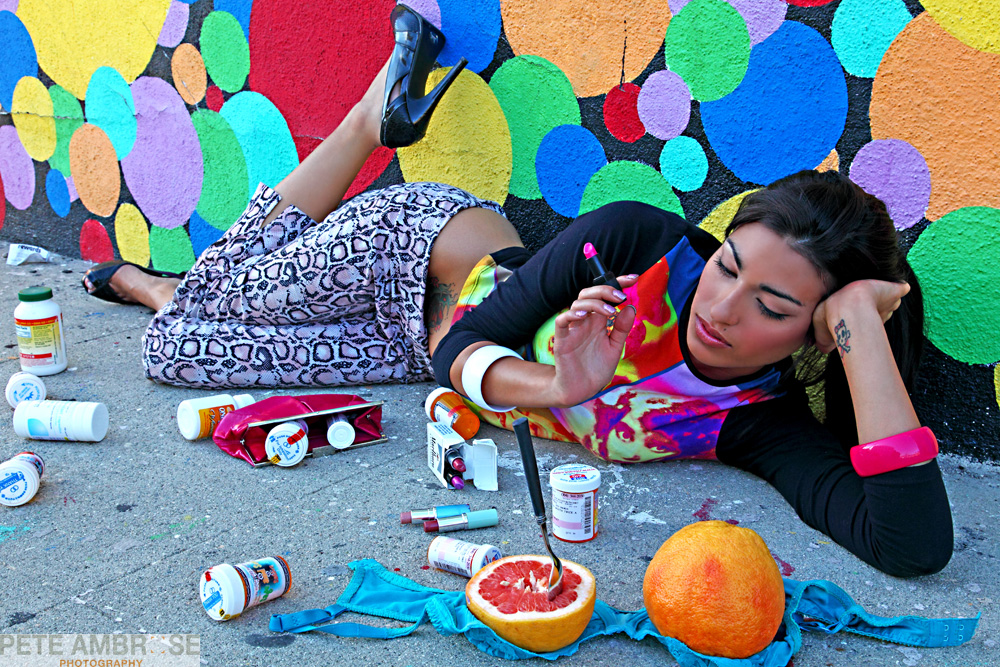
One day I found myself driving in desperate search for the nearest Pinkberry (Yes, I was feening, no, I wasn’t high). A wrong turn on Santa Monica in West Los Angeles swung me right by a Goodwill donation center and the proverbial, florescent spiral light bulb went on. Without a commanding knowledge of what I’d actually find, and thankfully with wardrobe stylist, Jess Jaworski, in tow (wasn’t in the mood to go sift through female clothes in a Goodwill store by my lonesome) it was a risk, but what better place could I attain a commanding, affordable and thematic through line for the project than purchasing the entire wardrobe for the project at Goodwill donation centers. You’re confused. I’ll explain.
The concept of Goodwill stores is to collect discarded clothes from those generous souls who can to stay up with current trend, while providing affordable wear for those who, for lack of a better word, can’t. When I took my wardrobe stylist out for our initial spree we were simply floored by all the incredible pieces we found that were cutting edge and with the right (re)arrangement would allow us an unabated palette of fashion that could stand on its feet without a reputable brand. We found color from past eras that could enliven the current consistency of contemporary fashion’s oft drab palette, and most importantly a new arrangement with which to portray and re-deploy the cultural shifting power of the combined medium of fashion photography. This through line led us through all of the bodies of work, including the subsequent beauty series. Concepts, narratives, make-up, wardrobe and models were carefully planned and chosen. All that was left was the execution of the individual sub-series: The Reality, The Social Canvas, The Substantive Culture, The Domestic and The Iconic.
Now for The Well-Proportioned Arms, Legs and Torso forming the Overall Body of Work
The Reality
This sub-series undoubtedly lays the foundation for the rest of the project. Single-model, straight photographic editorials bent on creating a world of surreal metaphor using object, apparel and location that couldn’t be more visceral or real. Plays on literature, art, pop culture, religion, society, and images of female beauty are dipped in dark whimsy and blossom in full color, notwithstanding the surrounding neutral palettes and disjunctive textures. The foundation for conceptual work brought forth with low cost, in-camera and on-set ingenuity is rolled out with this series of images that hint and tease the viewer with what is the acceptable emotional response.
The Social Canvas
This sub-series of mixed media diptychs aim to reinvent the potential for studio fashion photography on multiple levels. A base concept is set out to be realized tackling universal sociological conflict that both stirs and dictates progress within society and fashion itself. Set upon an incongruent canvas of complimentary design and pattern, the model is the artistically placed upon and contorted in an energetic and emotive pose. She becomes only one aspect of the piece as she is surrounded by objects that support the overall theme and formal aesthetics of the canvas. Creating the diptych is more of a snarky reference to the listless studio fashion editorials, further supported by the goodwill wardrobe adorning the model antithetically to its intended use, i.e. skirts become shirts, socks become skirts, pants become tops. What is the intent of clothing’s use if to be nothing else but fashionable?
The Substantive Culture
The sole beauty sub-series aims to takes a new approach to the genre by relieving the core emphasis on cleanliness and flat light in favor of a colorfully lit, low key palette where the face becomes a new road map to the subjects’ essence through cultural reference and whimsical object simile. Each concept’s cultural reference is rooted anywhere from a past, contemporary, to a fantastical era. Keeping with the in-camera staple, all images where shot against a conventional white muslin/wall and the cross blend of the color from the lighting set-up creates the even effect of the supplemental color behind and the cross-harmony of the light on the models’ faces and eyes. The application of the overall make-up design, executed flawlessly by our artist, Phoebe Markowitz, flows solely from the model’s staple and most attractive features, thus emphasizing her original beauty through a visually cerebral prism of color and texture. Each design and set-up up took upwards of 2 ½ to 3 hours and we managed to rip the skin off only one model. Yikes.
The Domestic
In this sub-series a multiple model, duel narrative blending the fine art tableaux with the commercial editorial was created. Each photo tells two different, yet ambiguously adjoined narratives while aiming to capture both the domesticated consumer and their reality in the same frame as the visual representation of chic commerce and the sociological perception of perfection. In English, we set a domestic couple against their commercial counterpart(s), in an attempt to recognize the day to day interactions and how they would be transcribed in the fashion editorial. A broader statement is being made to the effect (or lack thereof) the fashion industry has on the average household. Similar to the reality portion, metaphor and ambiguous references to many existing and defining aspects our society are blended within heightened cinematic color to create stand alone works that are simply a reverie of real.
The Iconic
The most complex and conceptually planned sub-series creates images that set out to reference some of the most iconic photographs from pop culture and history within one frame. Each shot blends two or more different iconic photos as told by three to six models in a stand alone narrative, all while establishing a greater connection between the images that are juxtaposed through the “trivial” lens of high fashion. Combining each image’s unique and defined story, thus reworking, reframing and re-emphasizing through a lens of “what is past, is prologue” gets to the very core of the artistic process in any medium, but certainly within the fashion and photographic medium. The ultimate potential of the single image created from the mind and captured in reality was the goal with this sub-series. Taking harsh, pre-existing, iconic photographs of famine, war, pop culture, excess, tribulation, upheaval and revolution are only the basic level of the re-contextualization set forth in the recreated imagery. It’s the gesture of re-framing these very real moments within a world portrayed and defined as superficial and materialistic that intentionally instigates a profound misreading or general discomfort from the viewer’s first impression of culture or revealed society within the narrative. It is exactly the trivial or kitschy on the surface that allows for the greater depth within the piece to shine through – the unified or conflicting themes, the sheer oddity of the stand alone narrative without reference – the unapologetic attempt to create the timeless visual ensemble from the past. That is essence of why we observe – to take note of the world that surrounds and then adorn ourselves accordingly in an effort of pure, unfetterered self-expression.
In Another Life, I was definitely a Football Coach who Gave Great Pep Talks
The impetus for change within any art and commerce marriage stems from the ability to take calculated risk. With each passing year, originality naturally becomes more elusive (side note: what will run out first – oil or creative thought?), but I stress that as ideas form and are thus executed (and exhausted), it works in no one’s favor from either a business or an artistic perspective to re-create without depth. The heart of Goodwill Fashion is, in its essence, an imploring of the artist’s better angels – the spirit not to derive, but to thrive in the challenge of change. The voice of any brand is defined by what sets it apart, not by the conventional sheen and technical wizardry that validates its professional existence. Why must the conventional commercial guidelines for fashion and beauty photography be followed? Why hire me if you just want me to create a “photo which looks like that photo”? Cut the umbilical chord of acceptable technique and step out with spine. Craft each image to solidify your own. The essence of any photograph is never the visual content in and of itself, but is nestled rather in what the image evokes. Fashion is the narrative art of adornment and self-expression. To document and sell this requires nothing more than a clear and attractive articulation within the context of an image. To enliven the audience and the consumer is the added flavor which lays in wait – what story can I tell that will entice a reaction that unfolds the pure aesthetic to reveal a deeper truth. Sounds complex, but it really just means the creation of an excitable image.
The goal of Goodwill fashion was to do just that, but make it different. Each image was carefully crafted to in subversive parody, and glazed with a narrative quality aimed at emoting a rainbow of emotional color without revealing which hue was the directional force. Ambiguity is fashion photography’s greatest weapon. It is never our right to know what is next or what is even in right front of us. However, it is our obligation as artists and the image messengers of pop culture to define both. If this is to be my life’s work consider this body of work an offer of goodwill, because I plan on defining my art form, without question or apology, for a very long time.
 The Rebel Blog