

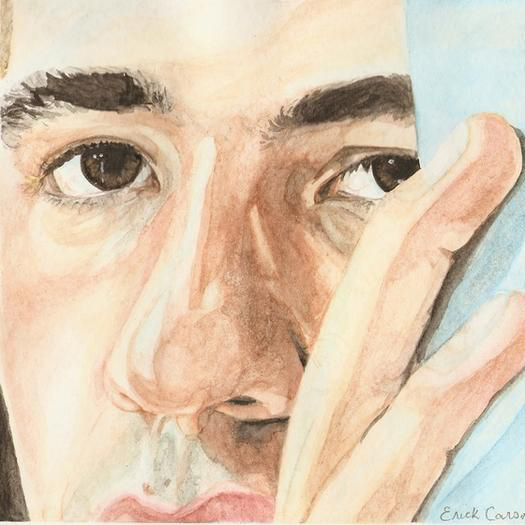
 After 36 hours of excruciating labor in a Fort Collins, Colorado hospital, artist and educator, Andrea Ambrose gave birth to her son Pete, who was destined become a great athlete, guided by his idolization of one great Denver Bronco quarterback, John Elway. His father, Ric, an accomplished artist and museum curator, fostered this sacrosanct ambition by developing his tireless work ethic and sense of responsibility with numerous trips to the batting cage and countless routes ran to perfect his son’s timing.
Thus, Pete excelled in baseball and football at Jennifer Garner’s high school in Charleston, West Virginia, even becoming an all-state quarterback in the latter. However, tragedy slowly began to strike in the form of an overused, left arm. Velocity on his fastball was lost and major college interest subsided. A transition had begun.
Pete recalled that in 8th grade English he’d written an 82 page autobiography that won the critical acclaim and confusion of his teacher and sparked a minor infatuation of his with words. This recollection, coupled with his dwindling athletic prowess meant self-preservation lay in only one coping method: creation. Pete realized that left-handers were not meant to lead by throwing balls. They were meant to lead by creating art. (Also didn’t hurt that the latter was in his bloodline).
Pete began to write poetry at a furious pace (which to this day is only accessible to a supportive 12th grade English teacher and, of course, his mom). He also began to watch the Oscars and then movies too. He saw American Beauty. It changed his life. It also won some Oscars.
He had his first real girlfriend, whom he stupidly followed to Marshall University to play football and marry. He now wanted to become a filmmaker and rationalized his decision to go to Marshall and major in theater (it had no film program) because Sam Mendes directed plays in London before he directed American Beauty. It was the perfect plan, until his girlfriend dumped him in the first week of classes.
Pete transferred to Ithaca College to play football and major in film (it had a program, a good one, kind of). Despite playing three years of football and coaching one, this is where his athletic career finally died. It is also where Pete learned a most important fact about himself. He had an unbreakable drive to finish the job and succeed. For it was the rush of setting an example and coming through for people who believed in him that first attracted him to athletics at the age of two or three weeks. All he really ever wanted to be was a leader, and he was as utterly certain and naïve as a 19 year-old could be that filmmaking would be the avenue to continue that voice. I do suppose it’s worth noting here that Ithaca also required its film students to learn photography to foster a broader cinematic appetite and understanding. Thus, Pete went out and got the required 35mm Pentax. He had never taken a photo before. The rest is history.
History, that is, if I wanted to end the bio here. I don’t.
Pete developed a small infatuation for taking photographs much the same way he did for words long ago, and like words with athletics, photography remained firmly in the backseat to filmmaking for which he excelled throughout his years at Ithaca. Despite whispers from his photography professors and some kick-ass photos he took with a 4×5 view camera, it was his ambitious senior film, “Towards the Vanishing Point” that won him “The Faculty Award for Excellence and Achievement by an Undergraduate in Cinema and Photography” – or the school’s highest honor. “TVP” was an overachieving, 55-minute vat of pretention and indulgence shot on Super 16 with 40 student volunteers, 19 locations, zero budget, and was quite simply willed into existence (It did, however, net Pete life-long friendships and the formation of his visual aesthetic).
It was now time for Pete to conquer the world and then, maybe, the city of Los Angeles. Armed with his magnum opus, trusty Saturn Sedan and 17 meticulously designed “road” soundtracks; he set off on I-64 west for the city of angels. TVP screened at several small international film festivals and even won the relative equivalent of “Best Picture” in the state of West Virginia, showering him with $3500 cash and an article in his hometown newspaper – the first since his high school football days. However, it wouldn’t be long before tragedy slowly struck again.
LA proved indeed to be Pete’s match. His film could not get him an agent and his work as a Hollywood assistant to pay the bills opened him up to sides of the industry he wish he had never known. He became jaded and bitter…well, mostly just impatient. All seemed lost, if not for his stubborn will and the $3500 cash. Then, out of the blue, Pete was contacted to fill in as the still photographer on a multimedia fashion shoot after being recommended by someone who had never seen his work. He didn’t even have a proper camera, therefore, he didn’t think twice, took it, and knocked it out of the park (a camera was provided, of course).
It turns out Pete had been recommended by a potential boss for whom he turned down the opportunity to work for in the room due to the fact that he felt the position would only push him further away from his artistic aspirations, and wouldn’t reflect his original reasons for moving to LA. He was upfront with her and she admired this. She also had contacts. It changed his life, again.
Pete took his $3500 dollars, bought a fancy Nikon, built a myspace page to showcase his limited body of work and social networked until he was blue in the face. One shoot turned into one-hundred in many different genres, and with each one he knew more about what he wanted to say with his images – becoming confident that, finally, a passion had found a home in him. It wasn’t just about fashion, music or fine art – it was about being different and defining one’s self and vision. It was about setting an example and finishing the job. The rest is history.
History, that is, because I’ve learned there will always be so much left to shoot.
 The Rebel Blog